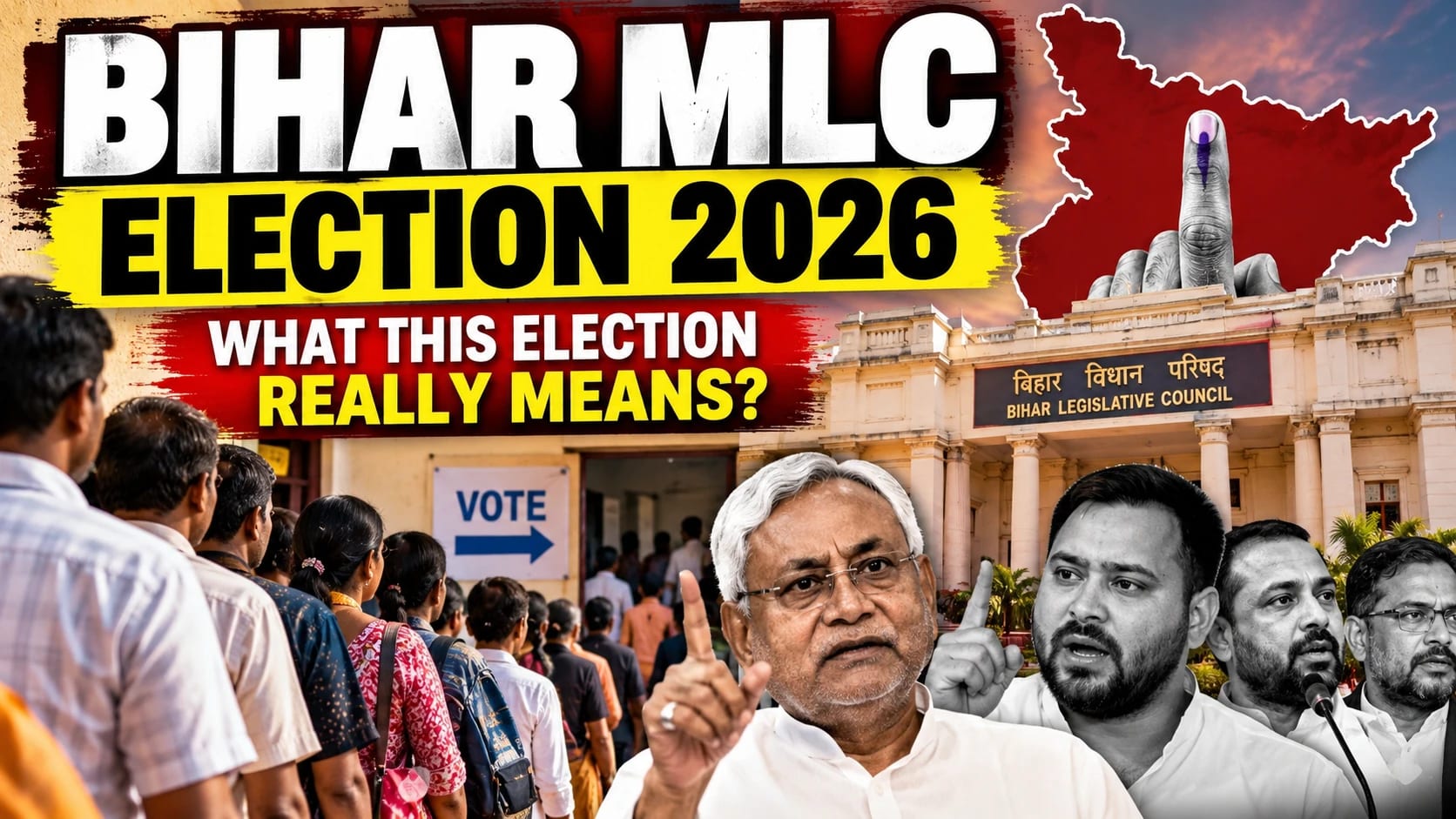
Patna: Bihar’s political spotlight has now shifted to the Legislative Council, where voting for eight MLC seats has concluded and the state awaits the results on October 27.
The election may not have the scale of an Assembly election, but it carries considerable political importance. Four seats are from Graduate constituencies and four from Teacher constituencies, bringing together a specialised electorate of graduates and educators.
This time, 150 candidates are competing across the eight seats. The contest has also attracted attention because of high-profile political rivalries, particularly in the Patna Graduates constituency.
Teachers Turn Out in Much Larger Numbers
One of the clearest features of this election has been the difference in voter participation between teachers and graduates.
The latest reported figures put turnout in the four Graduate constituencies at around 53.42%, while the four Teacher constituencies recorded a much stronger 82.85% turnout. Saran Teachers emerged as the strongest-performing constituency, with turnout reported at 89.05%.
The difference raises an important question: why did teachers participate so heavily compared with graduates?
Teacher constituencies are relatively small and their elections are often closely connected to professional issues such as pay, job security, pension and recognition of teaching institutions. These concerns can create a stronger direct connection between the voter and the candidate.
Patna Graduates Became a Key Political Battleground
The Patna Graduates seat attracted particular attention because of an internal political contest involving JD(U) leaders.
Sitting MLC Neeraj Kumar is seeking another term, while Jan Suraaj candidate Anuj Singh received backing from Mokama MLA Anant Singh. The rivalry became visible during polling,

The contest therefore became more than a routine Council election. It offered a glimpse into competing political networks and the ability of individual leaders to influence voters beyond formal party lines.
The Jan Suraaj Factor
The election is also significant for Jan Suraaj, which has fielded candidates across all eight constituencies.
For a relatively new political organisation, these elections provide another opportunity to test its organisational strength among educated and professionally connected voters.
However, winning an MLC election requires a very different electoral strategy from winning a conventional Assembly seat. The electorate is limited and specialised, and candidates need strong local networks as well as sustained engagement with graduates or teachers.
Why These Elections Matter
The Legislative Council is Bihar's upper house. Its members participate in law-making, debates and scrutiny of government policies.
That makes these elections important beyond the final numbers.
The results will indicate which political groups are gaining influence among Bihar's educated electorate and teaching community. They could also provide political parties with clues about voter sentiment ahead of future electoral contests.
The election also highlights an interesting contrast: while Assembly elections involve a broad population, MLC elections allow smaller, clearly defined groups to directly
The election also highlights an interesting contrast: while Assembly elections involve a broad population, MLC elections allow smaller, clearly defined groups to directly influence representation in the state's legislature.
Now, Everyone Is Waiting for October 27
The political campaign is over. Ballots have been secured, and candidates are now waiting for counting day.
With eight seats and 150 candidates involved, the outcome could produce some closely watched contests. The results on October 27 will reveal not only who enters the Bihar Legislative Council, but also which political forces have managed to build support among teachers and graduates.
For Bihar's political landscape, these may be smaller elections in terms of electorate—but their political signals could be much bigger.
The real question now is simple: who converted their campaign into votes?
#Bihar #BiharPolitics #BiharMLCElection #MLCElection2026 #BiharElection #Patna #BiharNews #PoliticalNews #BiharLegislativeCouncil #JanSuraaj #JD(U) #BJP #RJD