
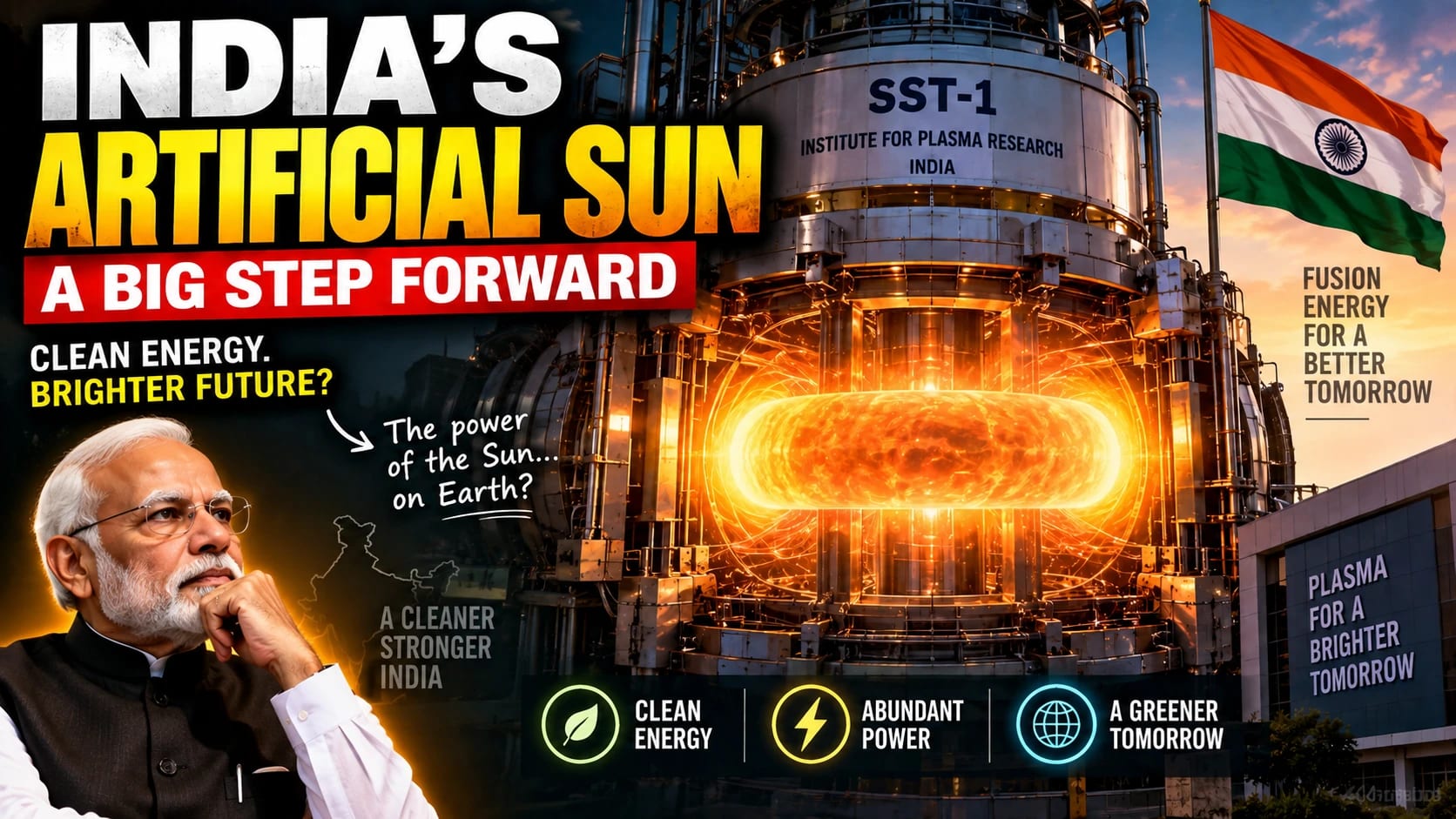
New Delhi, September 2026: India has taken another important step in its pursuit of nuclear fusion energy, with scientists working to recreate on Earth the same basic process that powers the Sun.
The latest development comes from the Institute for Plasma Research (IPR) in Gujarat, where a new 82.6 GHz, 400 kW gyrotron has been installed and commissioned on the Steady State Superconducting Tokamak (SST-1). The technology is designed to provide powerful microwave heating to extremely hot plasma and help researchers study how to maintain it for longer periods.
What exactly is India’s ‘Artificial Sun’?
The term “artificial Sun” does not mean that India has created a miniature Sun.
Instead, scientists are trying to reproduce nuclear fusion, the process through which stars, including our Sun, generate energy. In fusion, light atomic nuclei are forced together under extreme conditions, releasing large amounts of energy.
On Earth, researchers use a device called a tokamak. It has a doughnut-shaped chamber in which superheated gas becomes plasma. Powerful magnetic fields are then used to confine the plasma because no ordinary material could withstand its extreme temperature.
Indian researchers have already produced plasma temperatures exceeding 200 million degrees Celsius in fusion experiments—far hotter than the Sun’s core, which is around 15 million degrees Celsius.
Why is the new gyrotron important?
The newly commissioned gyrotron operates at 82.6 GHz and 400 kW, replacing the earlier 42 GHz system used for plasma heating.
A gyrotron generates high-frequency microwave energy that can be injected into the plasma. The increased heating capability is expected to help researchers investigate

For fusion research, simply reaching an extremely high temperature is not enough. Scientists also need to control and confine the plasma for sufficiently long periods while maintaining stability.
That is one of the biggest challenges standing between experimental fusion and practical fusion power.
India’s private sector is also entering the fusion race
India’s fusion programme is not limited to government laboratories.
In September 2026, Bengaluru-based Pranos Fusion reported the creation of plasma in its compact PRAGYA tokamak. The device is being developed as a research platform for studying plasma control, tokamak systems and fusion-related technologies. The company has stated ambitions of developing more advanced fusion systems in the coming years.
This represents an emerging private-sector component of India’s wider fusion ecosystem, alongside established public research programmes and India’s participation in international fusion projects.
Could fusion become India’s future energy source?
Nuclear fusion is attractive because it could potentially provide large amounts of low-carbon energy without the same type of long-lived radioactive waste associated with conventional nuclear fission.
However, commercial fusion power is not here yet.
India’s SST-1 is an experimental fusion research machine, and the newly installed gyrotron does not mean India has already created a commercially functioning artificial Sun or a fusion power
However, commercial fusion power is not here yet.
India’s SST-1 is an experimental fusion research machine, and the newly installed gyrotron does not mean India has already created a commercially functioning artificial Sun or a fusion power plant. Researchers still have to solve major problems involving plasma stability, sustained confinement, reactor materials, fuel cycles, engineering and the economics of producing electricity.
So the current development should be viewed as a research and engineering milestone, rather than the arrival of commercial fusion energy.
The bigger picture
The race to develop controlled nuclear fusion is taking place internationally. China, the United States, Europe and other countries are investing heavily in fusion research. China, for example, recently completed a 582-tonne superconducting magnet for its next-generation BEST fusion project and has outlined a goal of demonstrating fusion-based electricity generation around 2030.
India’s latest SST-1 upgrade and the emergence of private projects such as PRAGYA show that the country is also expanding its capabilities in this field.
The idea of bringing the Sun’s energy-producing process to Earth may still sound futuristic, but India’s latest developments demonstrate that researchers are steadily moving from simply achieving extreme temperatures toward the much harder challenge of controlling and sustaining fusion plasma.
For now, India has not built an actual artificial Sun—but it is building the technology needed to study how the power of the stars could one day be harnessed on Earth.