
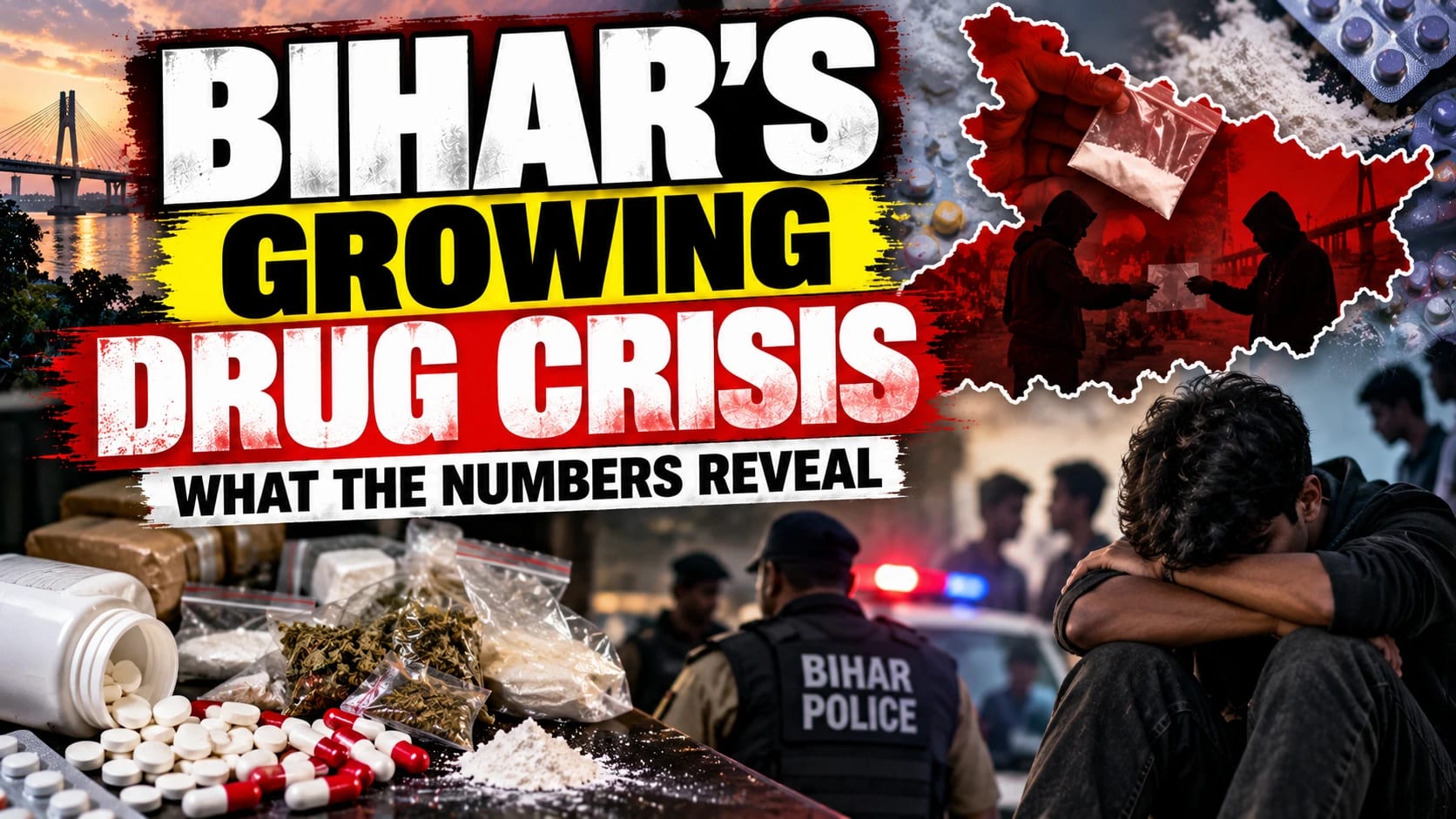
Patna: Bihar has spent a decade enforcing prohibition, but a different substance-abuse problem is becoming increasingly difficult to ignore.
Recent police data points to a sharp rise in cases registered under the Narcotic Drugs and Psychotropic Substances (NDPS) Act. Between January and May 2026 alone, Bihar recorded 1,905 NDPS cases — more than the total recorded during the whole of 2022. In 2019, the state had registered 697 such cases.
The numbers suggest that the state's substance-abuse challenge is no longer limited to illegal alcohol.
A New Pattern Is Emerging
According to an investigation based on Bihar Police data, narcotics including brown sugar, heroin, cannabis, pharmaceutical tablets and other drugs are increasingly appearing in the state's illegal market.
The scale of pharmaceutical-drug seizures is particularly striking. Police seized 9.29 lakh tablets during the first five months of 2026, compared with 29,762 tablets during the whole of 2022.
Ganja seizures have also increased substantially. The quantity seized rose from 16,692 kg in 2022 to 31,915 kg in 2025, according to the same police data.
These figures do not by themselves prove how widespread drug use is among Bihar's population, but they clearly show that law-enforcement agencies are encountering a larger narcotics problem.
Why Is This Happening?
One explanation offered by police officials is the emergence of a cheaper illegal drug market following prohibition.
With alcohol unavailable legally in Bihar, illegal liquor became expensive. Officers cited in recent reporting said that some users could turn to smaller quantities of drugs because they cost less and can produce a longer-lasting effect.
This has created

That does not mean prohibition alone caused Bihar's drug problem. Drug trafficking has multiple drivers, including supply networks, organised crime, availability, addiction and economic conditions.
Bihar Is Also a Transit Route
Bihar's geographical position makes the problem more complicated.
Police data and investigations point to narcotics entering the state through different routes, including connections with the Northeast, Nepal and neighbouring states. Some trafficking networks move drugs through multiple states before they reach local markets.
This means Bihar cannot address the problem only through action at individual police stations. Drug trafficking is organised across state boundaries, requiring coordination between agencies and neighbouring states.
The Youth Question
Perhaps the most worrying aspect is the potential impact on young people.
Police records cited in recent reporting show that 50 juveniles were detained under the NDPS Act in 2024, compared with 11 during the seven years from 2016 to 2023.
These figures should not be interpreted as proof that drug use is directly responsible for juvenile crime. But they do indicate that young people are appearing in narcotics-related cases and that prevention needs to become a bigger part of the response.
Schools, colleges, families and local
These figures should not be interpreted as proof that drug use is directly responsible for juvenile crime. But they do indicate that young people are appearing in narcotics-related cases and that prevention needs to become a bigger part of the response.
Schools, colleges, families and local communities therefore have a role alongside the police.
Enforcement Is Only One Part of the Solution
Bihar's authorities have intensified narcotics enforcement.
The state's Special Task Force narcotics cell had seized drugs worth ₹52.32 crore and made 315 arrests by October 10, 2026, according to recently reported figures.
But arrests and seizures address the supply side. They do not automatically solve addiction.
Recent reporting from Bihar has also highlighted the difficulties faced by families trying to get treatment for people suffering from drug dependence. Rehabilitation facilities face pressure, while short treatment programmes may not be sufficient for long-term recovery.
That makes rehabilitation, counselling and follow-up treatment just as important as enforcement.
What Bihar Needs to Focus On
A long-term response would need to operate on several fronts:
1. Stronger action against trafficking networks
The focus should be on dismantling supply chains and financial networks rather than only arresting individual users or small-level sellers.
2. Better rehabilitation facilities
People struggling with addiction need accessible treatment and sustained follow-up rather than only short-term intervention.
3. Prevention among young people
Schools and colleges can play a major role in awareness, early intervention and identifying vulnerable students.
4. Better coordination between states
Because narcotics often cross state borders, Bihar's agencies need close coordination with neighbouring states and central agencies.
5. Community involvement
Families and local communities need ways to seek help without treating addiction solely as a criminal issue.
The Bigger Picture
Bihar's experience demonstrates a difficult reality: banning one addictive substance does not make addiction disappear.
The rise in NDPS cases and drug seizures does not mean every part of Bihar is experiencing the same level of drug use. Nor does it establish that prohibition is the sole cause of the narcotics problem.
But the trend is significant enough to demand attention.
The state has already built a substantial enforcement system around prohibition. The emerging narcotics challenge now requires a broader strategy — one that combines policing with prevention, treatment and rehabilitation.
Because ultimately, the real measure of success will not simply be how many drugs the police seize.
It will be whether fewer young people become addicted in the first place — and whether those who already need help can actually get it.
#Bihar #BiharNews #BiharDrugCrisis #DrugCrisis #NDPS #BiharPolice #Patna #BiharUpdates #DrugAwareness #Addiction #Youth #Patnaites