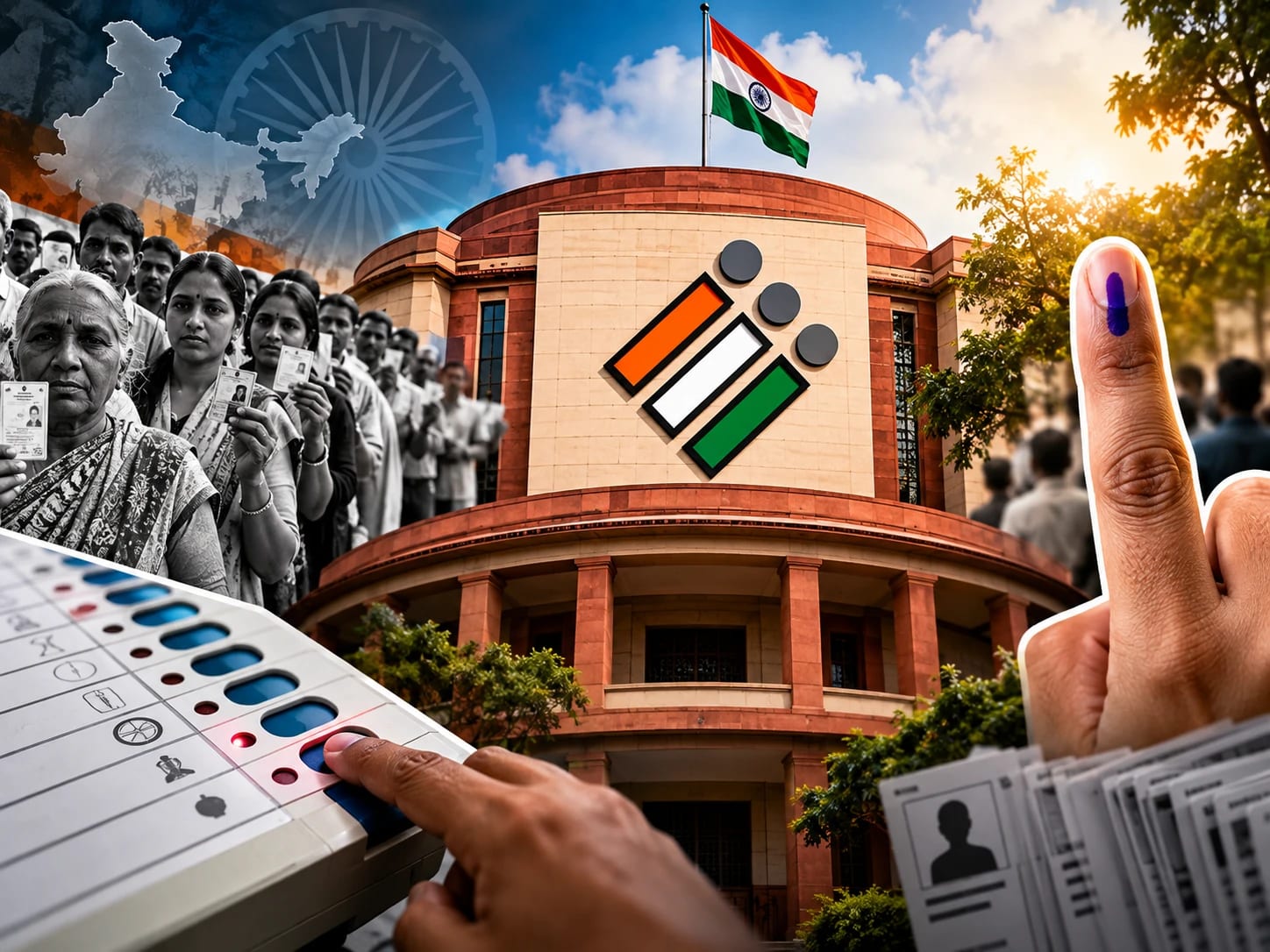
India conducts one of the world’s largest electoral exercises, involving millions of voters, thousands of candidates and polling stations spread across the country. At the centre of this enormous process is the Election Commission of India (ECI), a constitutional authority responsible for administering elections.
What is the Election Commission of India?
The Election Commission of India is an autonomous constitutional authority established under Article 324 of the Constitution of India. It was formally constituted on 25 January 1950, just before India became a republic. (Election Commission of India)
The Commission is responsible for administering elections to the Lok Sabha, Rajya Sabha, State Legislative Assemblies, and the offices of the President and Vice-President of India. (Election Commission of India)
Its constitutional role is not limited to announcing election dates. It has responsibility for the overall administration of the electoral process, including the preparation and management of electoral rolls and the conduct of elections.
What does the Election Commission actually do?
Election management involves a large number of activities before, during and after polling.
1. Preparing electoral rolls
One of the Commission’s important responsibilities is overseeing the preparation and revision of electoral rolls. Voters can use ECI services to register, update details, search their names in the electoral roll and access their digital voter documents. (Election Commission of India)
2. Conducting elections
The ECI plans and coordinates elections across constituencies, including polling arrangements, election personnel, observers, security coordination and counting.
The scale of this operation makes election management a complex administrative exercise involving the Commission, state election machinery and officials

3. Monitoring candidates and political parties
The Commission also issues instructions governing different aspects of election administration and maintains systems relating to candidates, political parties and election management. Its official compendium contains instructions covering electors, political parties and candidates, election management, media and voter education. (Election Commission of India)
4. Voter awareness
An election is not only about conducting polling. Voters also need information about the electoral process.
The ECI’s SVEEP — Systematic Voters’ Education and Electoral Participation — programme focuses on voter education, awareness and participation. The programme has been operating since 2009. (Election Commission of India)
5. Handling complaints
The Commission provides mechanisms through which citizens can raise election-related grievances. Its voter services also include cVIGIL, which allows citizens to report alleged violations of the Model Code of Conduct. (Election Commission of India)
Why is Article 324 important?
Article 324 is the constitutional foundation of the Election Commission’s authority.
It vests the superintendence, direction and control of the preparation of electoral rolls and the conduct of elections in the Election Commission for Parliament and State Legislatures. (Election Commission of India)
However, Article 324 does not operate in isolation. India’s electoral framework also includes other constitutional provisions and laws, including the Representation
However, Article 324 does not operate in isolation. India’s electoral framework also includes other constitutional provisions and laws, including the Representation of the People Acts. The ECI’s powers therefore operate within India’s broader constitutional and statutory framework. (Election Commission of India)
Technology and modern elections
India’s election system has increasingly incorporated technology.
Electronic Voting Machines (EVMs) are used for voting and counting, while VVPAT technology provides a paper trail associated with the electronic vote. The ECI also operates digital platforms for voter services, election planning and electoral-roll management. (Election Commission of India)
For voters, digital services now make it possible to perform tasks such as checking electoral-roll information, tracking applications, downloading the electronic voter ID and finding polling-station information online. (Election Commission of India)
The role of citizens
The Election Commission manages the electoral process, but democracy ultimately depends on citizens participating in it.
Voters have a responsibility to verify their registration, understand the voting process, assess candidates and political parties using reliable information, and cast their vote according to their own judgment.
The ECI’s voter-service platforms provide tools that can help citizens check their electoral information before an election. (Election Commission of India)
Why the Election Commission matters
The Election Commission occupies a crucial position in India’s constitutional system because elections determine who receives the mandate to govern.
Its responsibilities range from maintaining electoral rolls and organising polling to voter education, election monitoring and counting-related administration. The institution therefore sits at the centre of the practical machinery through which India’s electoral democracy operates.
At the same time, public confidence in elections depends not only on formal rules but also on transparency, effective administration, accurate electoral rolls, accessible information and the ability of citizens to participate meaningfully.
In the end, the Election Commission can administer an election — but the strength of a democracy also depends on informed citizens who participate in it.
Source: Election Commission of India (ECI). (Election Commission of India)